|
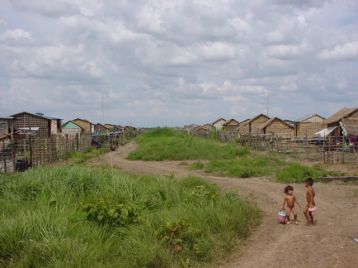
Early stage of Poom Procheathom Resettlement site in Poipet commune, Ochrov district, Banteay Meanchey province in 1999. Every household in resettlement site selected from landless population in slum area in Poi Pet town, Norwegian People's Aid support RGC to resettle landless population on the demined land.
Once available land identified and agreement with RGC finalized, Norwegian People's Aid team surveyed, designed and prepared resettlement site.
Every household must construct latrine, with NPA providing the underground structure, and the villagers constructing the rest. A child is testing his new latrine.
The serious unhygienic situation slum area in Poipet town where the landless population were selected according to three criteria. There was a number of deaths cause from cholera outbreak in 1989.
No wonder why there was a cholera outbreak in Poi Pet! There was no latrine for many poor people and they use water contaminated with E-coli from these dirt.
Land survey and boundary demarcation sign of area intended for resettlement site put up. There was a period of 6 months for any claim of ownership. When there was no claim, Norwegian People's Aid began resettlement site design and put in necessary infrastructure e.g. road, water points, etc.
Clearing of land for raod construction in and around the resettlement site in year 1999.
After the cholera outbreak was under control, Norwegian People's Aid conducted survey on population affected by the outbreak. 5000 families were surveyed in all slum areas in three villages in Poi Pet town. The surveyed population were given survey code that show their whereabouts.
Another slum area where people live on still above a pile of garbage and human waste.
The same slum photo taken from the second floor of ZOA office in 1989.
Public area where NPA produced cement rings, latrine cover, and cement jars to distribute to resettled population in Poi Pet resettlement site.
Cluster 7 of resettlement site in Poi Pet. Note that the road has not constructed yet.
Road around the clusters in the resettlement site compacted with laterite surface.
Resettled population constructed their houses with thatch and bamboo with nails and wire given by NPA.
Some of them raised duck for local consumption.
Drilled well in Poi Pet resettlement site, inspecting by NPA Country Representative and Dutch Embassy staff.
Cluster 4 of the resettlement site turned one common road into make shift market place despite warning that this violate the hygiene and cleanliness rule of the resettlement site.
Resettled beneficiaries rented portion of their land to outsiders which violate one of the agreement. The government officers were unable to enforce the rule and agreement! This situation happened one year after the settlement of beneficiaries completed.
Resettlement population put up stalls for selling food and snack one by one, despite their agreement to leave the shoulder of the road free of construction. All of them claimed receiving permission from influential persons in which the government officials were not able to handle the clearance of these illegal stalls.
Visiting Norwegian People's Aid Country Representative and Dutch Embassy staff meeting with committee of resettled population at the Community Center constructed by NPA for public used.
Fish vender at the resettlement site in Poi Pet
Fish imported from Thailand arrived in Plastic bag with some ice to keep them fresh
Northern boundary road of resettlement, see a commercial row house on the left and Health Center is on the right (unable to see in this photo)
Continue from previous photo, here is the Health Center on the right hand side of the northern boundary road inside the resettlement site.
Despite hygiene and cleanliness campaign, the side drainage of the resettlement site adjacent to the northern boundary road still full of garbage!
|